

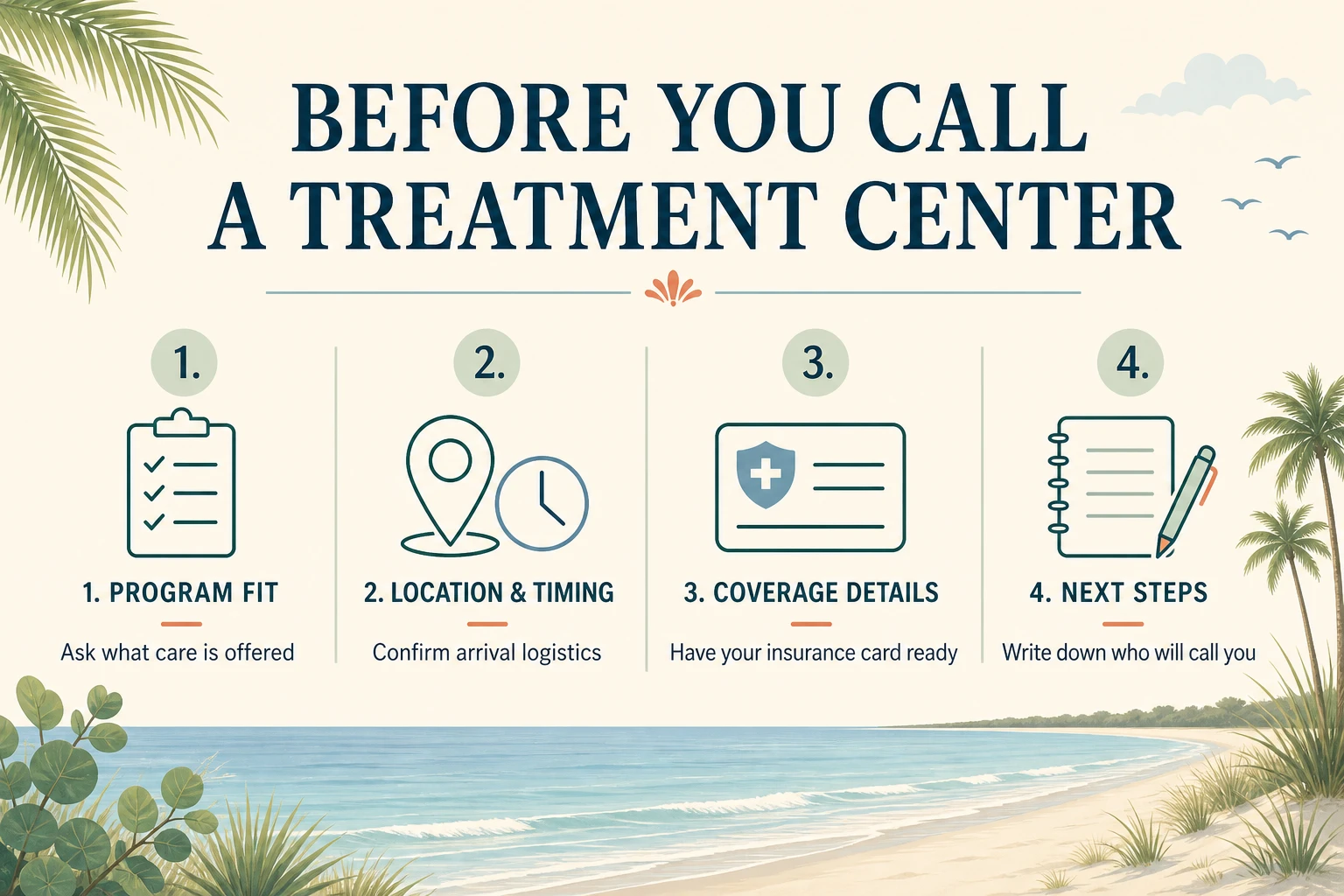
Before choosing a West Palm Beach treatment center, confirm the available level of care, assessment process, location and timing, insurance-verification steps, family communication policy, and what happens after the first call.
- 1Ask what levels of care are actually available and how the program determines an appropriate starting point.
- 2Confirm the facility location, arrival timing, items to bring, and any transportation questions before making plans.
- 3Insurance verification can clarify available benefits, but it is not a promise that every service will be covered.
- 4Write down the next action, the name of your contact, and when you should expect a follow-up.
Searching for a treatment center often happens when a person or family is already under pressure. The first call should make the situation clearer, not create a new list of vague promises. A short set of practical questions can help you understand whether a West Palm Beach treatment center offers the care, location, timing, and admissions support that fit the situation.
The goal is not to diagnose yourself or choose a program based on a website alone. It is to gather enough accurate information for a qualified assessment and a realistic next step.
1. Ask Which Levels of Care Are Available
“Treatment center” can describe very different settings. Ask the admissions team which programs are currently available at the specific location you are considering. Depending on the provider, options may include medical detox, residential treatment, partial hospitalization, intensive outpatient services, or continuing care.
Then ask how the program decides where someone should begin. The answer should involve an individual assessment, not a guarantee based only on a short online form. The National Institute on Drug Abuse notes that no single treatment is appropriate for everyone and that services should be matched to a person's needs.
Useful first questions include:
- Which levels of care are provided at this location?
- What does the assessment include?
- Who reviews medical, substance-use, and mental-health information?
- What happens if another level of care appears more appropriate?
2. Confirm Location, Timing, and Arrival Details
Before arranging travel or time away from work and family, confirm where care takes place and when an admission may be possible. A company's main phone number, mailing address, and treatment location are not always the same.
Ask for the exact arrival address, the expected arrival window, what identification or medications information to bring, and whether there are items that should remain at home. If transportation is a concern, ask what the program can explain or coordinate rather than assuming a ride is included.
If the timing is urgent, say that directly. SAMHSA identifies timely access as an important feature of quality care. For an immediate medical or safety emergency, call 911 or go to the nearest emergency department instead of waiting for an online reply.
3. Ask How the Program Evaluates Quality and Fit
SAMHSA's quality-treatment checklist recommends looking for licensed or accredited programs, qualified staff, evidence-based practices, family involvement when the person wants it, and support for needs beyond substance use alone.
You can turn those ideas into direct questions:
- Is the program licensed, accredited, or both?
- What types of qualified professionals participate in care?
- How is an individual care plan developed and reviewed?
- How does the program address co-occurring mental-health or medical needs?
- How are continuing-care or aftercare needs discussed?
A responsible admissions conversation should distinguish between general program information and decisions that require clinical evaluation.
4. Prepare for Insurance Verification
If you plan to use insurance, have the member's name, date of birth, insurance company, member ID, and group number available. Ask whether the provider is in network, whether prior authorization may be needed, and what information remains subject to review by the insurer.
The insurance-verification page can start this process, but verification is not a guarantee that every recommended service will be paid in full. Ask the admissions team to explain what has been confirmed, what may be an estimate, and whom to contact with billing questions.
Avoid choosing a treatment center based only on a claim such as “insurance covers everything.” Coverage depends on the plan, the service, medical-necessity review, and other requirements.
5. Clarify Family Communication and Consent
If a family member or trusted person is helping, ask how that person can participate in the admissions process and how communication preferences are documented. The U.S. Department of Health and Human Services explains that providers may share information relevant to a person's care or payment in certain circumstances, including when the person agrees or does not object. Sharing should remain limited to the information relevant to that person's involvement.
Ask who the prospective patient wants involved, what the admissions team may discuss, and how permission can be changed. A family member can also provide relevant background without assuming they will receive private clinical updates later.
6. End the Call With One Clear Next Step
Before hanging up, repeat the plan in plain language. Write down:
- The name and phone number of your contact
- The next action and who is responsible for it
- Any documents or information still needed
- The expected follow-up time
- What to do if the situation changes before that follow-up
If the program is not the right fit, ask whether the team can explain what type of provider or level of care may be more appropriate. The purpose of the call is to move toward a safe, informed decision—not to force a decision before the necessary information is available.
Start an Admissions Conversation in West Palm Beach
Amity Palm Beach can explain its current programs, assessment process, arrival information, and insurance-verification steps. Review the admissions process or call (888) 664-0182. Bring the checklist above so you finish the conversation knowing exactly what happens next.
This article is for educational purposes only and is not medical advice, diagnosis, or treatment. Program availability and insurance benefits can change and should be confirmed directly. If you or someone else may be in immediate danger, call 911 or seek emergency care.
Frequently Asked Questions
What should I ask a West Palm Beach treatment center first?
Start by asking which levels of care the center provides, how the assessment works, whether the location and timing fit your situation, and what information is needed to discuss payment or insurance.
Does verifying insurance guarantee that treatment is covered?
No. Verification helps identify available benefits and possible requirements, but the insurer and the specific plan determine coverage. Ask what is confirmed, what remains an estimate, and whether prior authorization may be required.
Can family members participate in the admissions call?
A prospective patient may choose to involve a family member or another trusted person. Privacy rules and the person's preferences affect what the provider may share, so ask how consent and communication are handled.
How do I contact Amity Palm Beach admissions?
Call Amity Palm Beach at (888) 664-0182 to ask about current programs, admissions, insurance verification, and the next appropriate step.
Sources & References
Read the sources referenced in this article.
- Quality Treatment for Mental Health, Drugs and Alcohol — Substance Abuse and Mental Health Services Administration (2023)
- Principles of Drug Addiction Treatment: A Research-Based Guide — National Institute on Drug Abuse (2026)
- Does HIPAA Allow Communication With Family and Friends? — U.S. Department of Health and Human Services (2017)
Amity Palm Beach
Amity Palm Beach